So HIV is found in bodily fluids but which fluids is it most concentrated in? What fluids is it least concentrated in and how do these facts contribute to transmission of the virus?
Blood contains the highest concentration of the virus, followed closely by semen, followed by vaginal fluids. These are the three basic fluids that infect adults with HIV. The risk from these fluids can be worsened or lessened depending on how they get into someone else's body. Breast milk can contain a high concentration of the virus, but in this situation, transmissiblety depends on who and how. An adult can ingest a small amount of breast milk at minimal risk. But an infant, with its very small body and newly forming immune system, consumes vast quantities of breast milk relative to its body weight. Therefore an infant is at risk from breast milk, whereas an adult probably is not. What are the most common means of transmitting HIV from one person to another person? Why are these most common?
In order to get into ones body, HIV is dependent on the exchange of bodily fluid. Through either HIV contaminated drug injection equipment, sn vaginal fluid or breast milk. Using this knowledge makes HIV avoidable. In all cases, HIV is transmitted in one of two ways: first, as the virus its self or second within an HIV infected cell. Despite all the HIV is contracted most commonly by via sexual transmission and accounts for 90% of infections worldwide. Although sexual transmission is the most common form of transmission it is not the most efficient. HIV is transmitted more efficiently intravenously then through sexual contact. Laboratory findings as well as prominent empirical evidence suggests that the major rout of HIV infection is through human blood and sexual activities involving the exchange of semen and vaginal fluids. Since semen carries significantly larger numbers of HIV than vaginal fluid HIV is transmitted far easier from man to woman then woman to man. Furthermore, since HIV occurs when infected blood, semen, or vaginal secretions from an infected person enter the bloodstream of a partner it happens more commonly by anal, vaginal or oral penetration, in descending order of risk. Since, HIV is most commonly sexually transmitted, the most predominate mode of transmission of HIV worldwide is through exposure of mucosal surfaces of the vagina, vulva, penis, or mouth to infected sexual fluids (semen, cervical/vaginal, rectal) and during the birthing process.
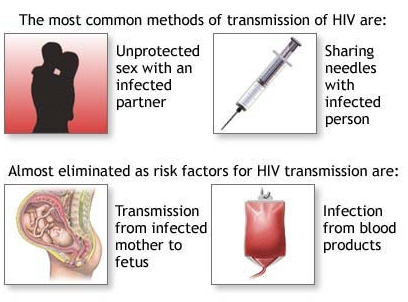 So how can YOU protect yourself against HIV?
Since, HIV is primarily transmitted through sexual activities abstinence and condom use are the best ways to protect yourself against the virus. Condoms are 99.8% effective if used correctly. Also, knowing you and your partners HIV status can be imperative in halting the transmission the virus. If in a monogamous relationship make sure you know your partners HIV status before taking part in unprotected sex. YOU ARE YOUR OWN VACCINE. There is no cure or vaccine for AIDS to date, the best way to protect yourself is to practice safe sex or abstinence. |